MACD signals
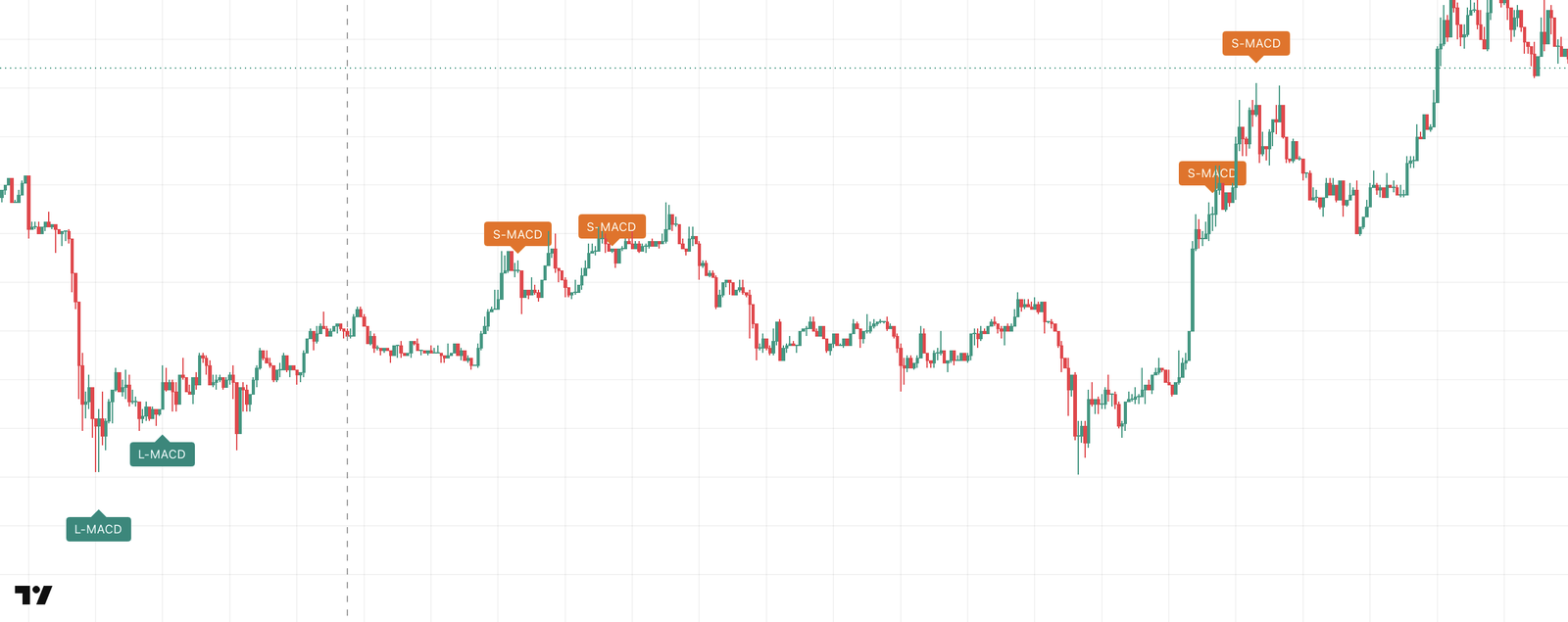
A momentum reversal of a MACD-style histogram at the channel edge. An early event, off in CONSENSUS by default.
The MACD signal catches the moment the histogram stops growing (or falling) while price is still in the zone. It doesn't wait for a line crossover, so it comes early: usually before a classic MACD cross would.
How it's calculated
The oscillator is MACD-shaped and tuned to the channel. S-MACD fires when its momentum turns down while the close is still past the upper zone edge; L-MACD when it turns up with the close past the lower edge. The zone edge is moved further out by Zone edge offset (%), and the signal has to pass the anti-spam.
The oscillator's lengths are fixed in the code. The MACD periods in Trend filters belong to the trend display and don't change this signal.
MACD is a CONSENSUS component, off by default in the indicator. Its events are still computed and counted the moment you switch it on there.
Settings
Group 📏 MACD signals.
| Input | Default | What it does |
|---|---|---|
| Show MACD signals | off | Shows the S-MACD / L-MACD labels. |
| MACD zone | Off | Own depth zone. Off means the general zone. |
| Zone edge offset (%) | 0.0 | Moves the zone edge further from the mean; the close has to go deeper. |
| Price filter | on | Early pass for a repeat signal after a big enough price move. See Anti-spam. |
| Price filter threshold (%) | 1.0 | The move needed for that early pass. |
| Min bars between signals | 5 | Minimum pause between MACD signals, strictly more than N bars. In 1.10 it only thins out signals; it doesn't change how the momentum turn is measured. |